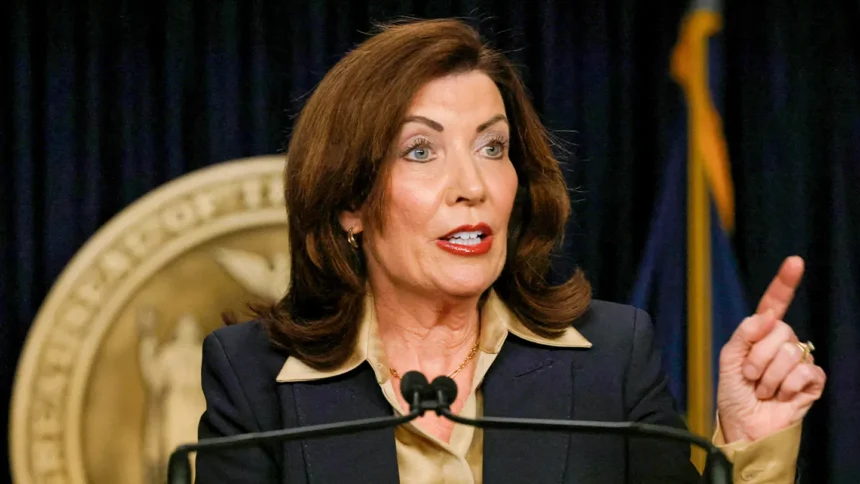
New York Gov. Kathy Hochul is defending a new state law that prohibits local and state law enforcement agencies from entering into formal immigration-enforcement partnerships with U.S. Immigration and Customs Enforcement.
Speaking on MSNBC’s “Morning Joe” on Friday, Hochul said the state had effectively ended the arrangements, declaring, “I just banned it.”
The Local Cops, Local Crimes Act, signed in May, took effect Tuesday. The law prevents state and local government agencies from entering into or maintaining agreements under the federal government’s 287(g) program.
Under 287(g), specially trained state and local law enforcement officers can perform certain federal immigration-enforcement duties under the direction and supervision of ICE.
Hochul says local police should focus on crime
Hochul has argued that local law enforcement agencies should concentrate their resources on crimes occurring within their communities rather than taking on federal civil immigration-enforcement responsibilities.
Her administration says the new restrictions do not prevent local jails from communicating with federal immigration authorities about individuals in custody or transferring people to federal authorities when permitted under applicable laws.
New York officials also point to existing corrections requirements that call for federal immigration authorities to be notified when certain noncitizens enter state custody.
DHS warns of increased federal presence
The Department of Homeland Security has sharply criticized the new law, arguing that limiting cooperation between local agencies and ICE could require federal immigration officers to operate more visibly throughout New York.
A DHS spokesperson told Fox News Digital that restrictions on local cooperation could make it more difficult for federal authorities to locate people who are released from local custody despite immigration detainers.
The department cited several New York cases involving noncitizens accused or convicted of serious offenses, including attempted murder, rape, assault, weapons-related offenses and child endangerment. DHS said ICE subsequently took custody of five individuals identified in its examples, with one later removed to Mexico.
The department also argued that many communities considered among the safest in the country maintain some level of cooperation with ICE.
Sheriffs challenge the law
The law is facing a separate legal challenge from 15 New York county sheriffs.
The federal lawsuit, led by Rensselaer County Sheriff Kyle Bourgault, argues that the state is improperly restricting the authority of independently elected sheriffs by preventing them from maintaining federally authorized 287(g) agreements.
The dispute comes as New York officials pursue their own legal action involving Rensselaer County.
New York Attorney General Letitia James filed a lawsuit Thursday against Rensselaer County and Sheriff Bourgault seeking to terminate the county’s existing 287(g) agreement. State officials have said Rensselaer was the only agency among 12 New York agencies with such agreements that had not indicated it would end its partnership.
Court battles continue
The legal fight over the state’s restrictions is unfolding alongside a separate federal case challenging the law.
Earlier this month, a federal judge rejected a Justice Department request for a preliminary injunction that would have temporarily blocked New York’s 287(g) restrictions. The ruling allowed the law’s Tuesday implementation deadline to proceed while litigation continues.
The 15 sheriffs involved in the newer lawsuit have separately asked the federal court for emergency relief.
Hochul’s administration maintains that the law is designed to preserve the role of local police as community-focused law enforcement agencies while leaving federal immigration enforcement to the federal government.
The Department of Homeland Security, meanwhile, argues that limiting local cooperation could make immigration enforcement more difficult and lead to a greater federal presence on New York streets.
The outcome of the ongoing lawsuits could determine how much authority New York’s local law-enforcement agencies retain to participate in federal immigration-enforcement programs.