President Donald Trump’s political operation is beginning to deploy its massive campaign war chest across competitive Senate races, as Republicans try to protect their congressional majorities in an increasingly difficult political environment ahead of November’s midterm elections.
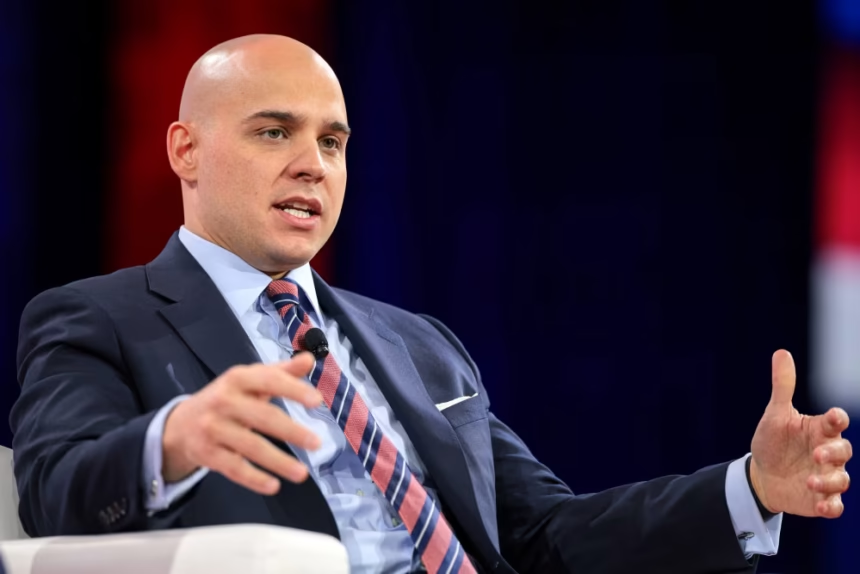
James Blair, a longtime Trump political adviser who now leads the president-aligned MAGA Inc. super PAC, said he believes Republicans still have a path to maintaining control of both chambers of Congress — even as the party faces historical and political headwinds.
“I’m cautiously optimistic,” Blair said during an interview with NBC News’ “Here’s the Scoop: Election Edition.”
Blair stopped short of predicting exactly how many seats Republicans would hold after Election Day but said he believes the party can overcome the historical tendency for the president’s party to lose congressional seats during midterm elections.
“I do think there is a path for us to retain both majorities and defy history, for sure,” Blair said.
His comments come as MAGA Inc. and groups connected to Trump’s political network begin putting tens of millions of dollars behind Republican candidates in some of the most closely watched races in the country.
Trump’s Political War Chest Enters the Fight
MAGA Inc. has accumulated roughly $400 million, giving Trump’s political operation an unusually large pool of money to influence races even though he is not personally on the ballot.
For much of the election cycle, Republicans questioned when that money would begin flowing into competitive races.
That changed as the campaign entered its final stretch.
MAGA Inc. made a $10 million investment in the Texas Senate race, where Republican state Attorney General Ken Paxton is running against Democratic state Rep. James Talarico.
The spending was divided between advertising supporting Paxton and messaging opposing Talarico.
Texas has attracted significant national attention because a Senate contest that Republicans would traditionally expect to win comfortably has become more competitive.
Paxton defeated incumbent Republican Sen. John Cornyn after receiving Trump’s endorsement during the GOP primary. Talarico, meanwhile, has demonstrated strong fundraising ability heading into the general election.
Blair rejected suggestions that Paxton’s position should cause Republicans to panic, arguing that the bruising primary campaign affected the Republican nominee’s political standing and that new spending could help change the race.
“I fully expect Ken Paxton will be the next U.S. Senator from Texas,” Blair said during the NBC interview.
Spending Expands Beyond Texas
Trump’s political network is also directing money toward Senate contests elsewhere.
A newly formed group, No Going Back PAC, which has ties to MAGA Inc.’s political operation, has reserved tens of millions of dollars in advertising across key battleground states.
Those investments include Senate races in Michigan, Ohio, New Hampshire, Alaska, North Carolina and Georgia.
The spending represents a major shift after months in which some Republican strategists worried that Trump’s enormous political treasury might remain largely unused during the midterms.
Republicans are now hoping the money can help offset Democratic fundraising strength and give GOP candidates additional resources during the expensive final weeks of the campaign.
The investments also demonstrate how important control of the Senate has become.
Republicans currently control the chamber, but Democrats have increasingly looked beyond traditional battlegrounds for opportunities as several races have tightened.
Republicans Need Trump Voters to Return
Money alone, however, will not solve one of the Republican Party’s biggest challenges: turnout.
Trump assembled a political coalition in the 2024 presidential election that included many voters who historically participate more consistently in presidential elections than in midterms.
Blair said one objective is persuading those less-frequent voters to return to the polls even though Trump himself is not running.
He described a type of Trump supporter who may pay relatively little attention to day-to-day politics and typically turns out when the president is directly on the ballot.
Getting those voters to participate in 2026 could be critical for Republican candidates.
Trump has made a similar argument himself, urging his supporters to approach the midterms as though he were personally running.
But Blair acknowledged that Republicans should not expect the coalition that elected Trump in 2024 to reproduce itself perfectly two years later.
“Coalitions are never exactly the same,” he said.
That challenge is especially important among groups where Trump improved Republican performance during the presidential election, including Latino voters.
GOP Faces Significant Headwinds
Republicans enter the final stretch with several obstacles.
The president’s approval ratings have weakened, voters continue to express concerns about the economy and cost of living, and the ongoing war with Iran has become another major political issue heading into Election Day.
There is also history.
The party controlling the White House frequently loses congressional seats in a president’s first midterm election, a pattern Democrats hope to repeat in November.
Republicans nevertheless control both chambers now, giving them an opportunity to preserve unified control of Washington if they can limit their losses.
Democrats believe the political environment gives them an opening.
Rep. Pete Aguilar of California, chairman of the House Democratic Caucus, said during the same NBC election program that Democrats intend to focus heavily on issues involving costs, health care and what the party describes as Republican corruption.
The competing strategies highlight the stakes of an election that could reshape the final two years of Trump’s current term.
A Democratic takeover of either chamber would give the party more power to block Republican legislation, conduct congressional investigations and challenge parts of Trump’s agenda.
Maintaining both majorities, meanwhile, would give Republicans a stronger opportunity to continue advancing the administration’s priorities.
For MAGA Inc., the question is no longer whether Trump’s political fortune will enter the midterm battle.
The spending has begun.
The bigger question is whether hundreds of millions of dollars, combined with Trump’s ability to mobilize voters, will be enough to overcome a difficult political environment and a historical trend that usually works against the president’s party.
For now, Blair is not predicting a sweeping Republican victory.
But with less than two months remaining before Election Day, he says Republicans still have a route to something much rarer: keeping control of both the House and Senate in a challenging midterm year.